As Ontario enters the latter half of 2026, the real estate market presents a nuanced picture that demands careful analysis from prospective homebuyers and sellers in key markets like Brampton and Mississauga. The latest statistics released by the Ontario Real Estate Association (OREA) provide critical insights into market dynamics, revealing both challenges and opportunities for those navigating the housing landscape. Understanding these trends is essential for making informed purchasing decisions in regions experiencing significant shifts in buyer dynamics and inventory levels.
Current Market Performance and Price Trends
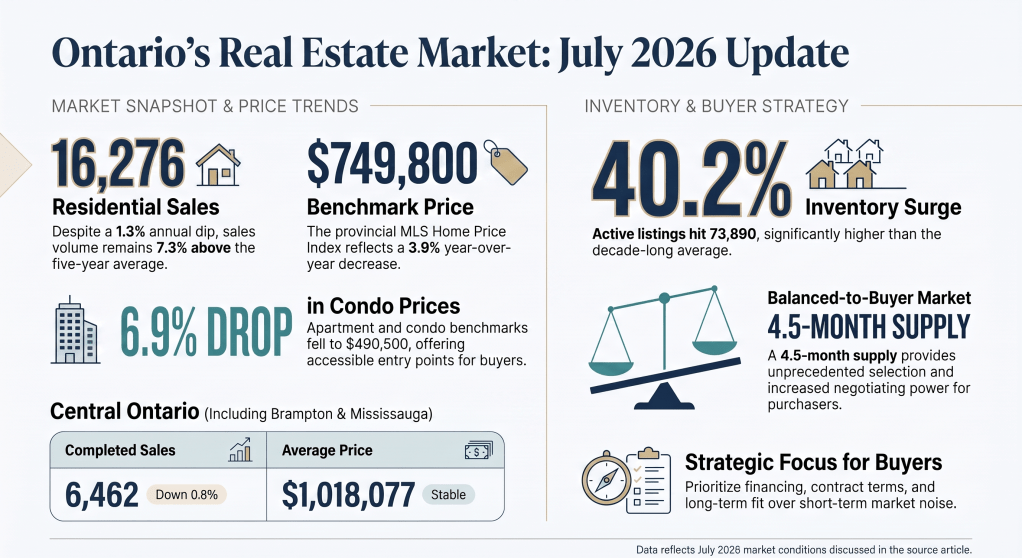
July 2026 data from OREA indicates that Ontario recorded 16,276 residential sales, representing a modest 1.3% decline compared to July 2025. Despite this decrease, the sales volume remains encouraging, sitting approximately 7.3% above the five year average. This suggests that underlying demand for residential properties continues to support market activity. In the Central Ontario region, which encompasses both Brampton and Mississauga, the statistics reveal 6,462 completed sales with a year over year decrease of just 0.8%, demonstrating remarkable resilience. The average price in this region stands at approximately $1,018,077, indicating that while market activity has moderated, pricing remains stable within this important metropolitan corridor.
Concurrent with sales trends, Ontario’s home prices continue their gradual decline trajectory. The MLS Home Price Index composite benchmark price has descended to $749,800, representing a 3.9% year-over-year decrease. Meanwhile, the apartment and condominium benchmark price sits at $490,500, down 6.9% from the previous year. This downward price adjustment carries significant implications for different buyer segments. First-time homebuyers entering the market find properties more accessible, while existing homeowners may experience modest equity adjustments. For those specifically interested in condominium properties near Square One in Mississauga or throughout Brampton’s urban centers, these price movements create favorable negotiating conditions that were not available during previous market cycles.
Inventory and Market Balance
One of the most important indicators for understanding market dynamics is the inventory level and months of supply available. Currently, Ontario maintains an active inventory of 73,890 homes for sale, representing a significant 40.2% increase compared to the decade-long average. This substantial inventory expansion fundamentally shifts the negotiating advantage toward buyers, providing unprecedented selection and flexibility. The months of supply indicator, currently at 4.5 months compared to 4.7 the previous year, demonstrates a gradual tightening but still maintains favorable conditions for purchasers. This balanced inventory level suggests that neither buyers nor sellers enjoy overwhelming advantages instead, the market operates in a more equilibrated state.
The average resale price across Ontario has decreased to $797,486, down 2.9% from the previous year. This consistent price moderation has important implications for accessibility and affordability. Homebuyers in Brampton and Mississauga benefit from this environment, as properties that may have commanded premium prices in earlier market cycles now present more reasonable entry points. The significance of this trend extends beyond immediate affordability, it positions savvy purchasers to benefit from potential appreciation as market conditions eventually stabilize and economic factors shift. Properties acquired at current price levels may represent solid long term value propositions for those committed to holding their investments.
Strategic Guidance for Today’s Homebuyers
Understanding these market conditions intellectually differs significantly from developing actionable strategies. Successful homebuyers in today’s environment should prioritize comprehensive market research before engaging in any transactions. Working with experienced local agents who understand the nuances of specific neighborhoods, school districts, and community amenities in Brampton and Mississauga provides invaluable context that statistical averages cannot convey. Hyperlocal information about development plans, infrastructure improvements, and demographic trends can significantly influence long-term property performance and satisfaction.
Negotiation tactics take on heightened importance in buyer-favorable markets. Beyond price negotiations, astute purchasers should focus on obtaining favorable contract terms, including extended closing periods, inspection contingencies, and seller concessions for repairs or updates. These negotiations often prove more valuable than modest price reductions, particularly for those planning extended ownership periods. Financial preparation also deserves careful attention; homebuyers should explore diverse financing options, including traditional mortgages and alternative financial products, to identify solutions aligned with their specific circumstances. Engaging with financial advisors or mortgage specialists can reveal opportunities to optimize borrowing costs and payment structures.
Long term value assessment should guide purchasing decisions rather than short term market fluctuations. Properties in emerging Brampton neighborhoods or established Mississauga communities may offer different appreciation trajectories based on development patterns, demographic trends, and economic fundamentals. Buyers should evaluate how potential purchases fit within comprehensive financial plans and life circumstances. A property’s alignment with lifestyle preferences, commuting requirements, and family needs often matters more than marginal price differences. Staying informed about evolving market conditions, interest rate movements, and policy changes ensures that buyers remain positioned to adapt strategies as circumstances shift.
Conclusion
The July 2026 Ontario real estate statistics provide essential guidance for navigating the housing market in Brampton, Mississauga, and surrounding regions. The combination of increased inventory, modest price declines, and relatively balanced market conditions creates an environment where informed buyers can negotiate effectively and secure properties representing fair value. Success in this market requires combining statistical awareness with professional guidance, strategic negotiation, comprehensive financial planning, and long term value orientation. Those willing to engage thoughtfully with current market conditions, supported by knowledgeable professionals, position themselves to make housing decisions that serve their interests for years to come.
Given the continuously evolving nature of the real estate market, the decision to buy or sell real estate should take into careful consideration several factors and it is crucial to carefully evaluate your financial situation, long term goals and local market conditions before making a decision. As a real estate professional with over 20+ years of experience in the industry, I have first-hand witnessed the housing affordability crisis and worked with both buyers and sellers in this market in my every-day practice. In such a market, it is essential to get the right advice. If you need expert guidance for your buying and selling needs, please don’t hesitate to reach out to me.

