The Current Landscape: A Buyer’s Paradise Hiding in Plain Sight
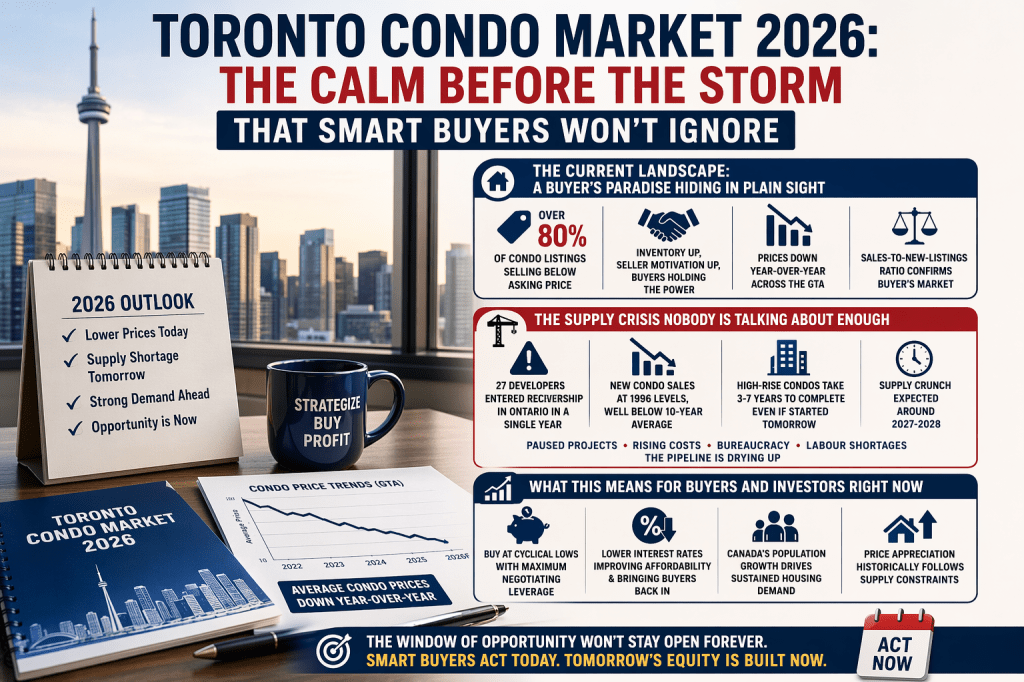
The Toronto condo market 2026 outlook begins with understanding where we stand today. Right now, over 80% of condo listings across the Greater Toronto Area are selling below asking price, a statistic that would have been unthinkable just three years ago. Inventory has swelled, seller motivation has climbed, and buyers hold negotiating power we haven’t witnessed in nearly a decade. This dramatic shift has created conditions where well-prepared purchasers can secure properties at prices significantly below peak market values, often with favourable closing timelines and additional concessions. Meanwhile, condo price trends continue to reflect this softness. Average condo prices across the GTA remain down year-over-year, and the sales-to-new-listings ratio firmly indicates a buyer’s market. However, as historical market cycles have repeatedly demonstrated, the best time to buy rarely feels comfortable. The very conditions that make today’s market feel uncertain are precisely what create tomorrow’s equity gains.
The Supply Crisis Nobody Is Talking About Enough
Beneath the surface of today’s oversupply lies a far more consequential story: a condo supply shortage that is already taking shape. Since mid-2022, developer receiverships in Ontario have surged dramatically, with 27 developers entering receivership in a single recent year alone. New condo sales have plummeted to levels not seen since 1996, crashing well below the ten-year average. As a direct result, developers are pausing launches, shelving projects, and walking away from sites where the margins no longer justify the risk. This matters enormously for the Toronto real estate forecast because high-rise condominiums take three to seven years to complete in Canada. Therefore, even if developers broke ground tomorrow, those units would not reach the market until 2028 at the earliest. Furthermore, municipal bureaucracy, rising development charges, zoning battles, and persistent labour shortages continue to slow approvals and construction timelines. The pipeline is drying up, and the consequences will materialize around 2027 to 2028 in the form of a serious supply crunch that could rapidly reverse today’s buyer-friendly conditions.
What This Means for Buyers and Investors Right Now
For anyone watching the GTA housing market, the strategic implications are clear. Buyers who act decisively today are purchasing at cyclical lows with maximum negotiating leverage, positioning themselves to benefit from the price appreciation that historically follows supply constraints. Additionally, lower interest rates from successive Bank of Canada cuts are improving affordability and gradually drawing sidelined buyers back into the market, which will steadily absorb existing inventory. Moreover, Canada’s population continues to grow, and Toronto remains the country’s primary destination for newcomers seeking employment, education, and community. This sustained demographic pressure guarantees that housing demand will persist and intensify, even as the development pipeline contracts. Ultimately, the present window represents a rare convergence of favourable pricing, motivated sellers, improved financing conditions, and an approaching supply deficit. Those who wait for perfect certainty may find themselves competing in a very different market just eighteen months from now.
 SP Singh Ahluwalia